¿Qué es Noctara?What is Noctara?Noctara 是什么?
¡Hola!
Somos un equipo de tres personas desarrollando Noctara, un ARPG 3D de fantasía oscura hecho en Godot. Yo soy el único programador, y además tenemos al diseñador del juego y al director de arte. Empezamos este proyecto hace casi 6 meses y es la primera vez que decidimos mostrar algo, porque estamos orgullosos de lo que hemos construido hasta ahora. Aun así, sabemos que todavía nos faltan muchísimas cosas.
El estado actual del proyecto se puede describir así (lo prefiero antes que una lista):
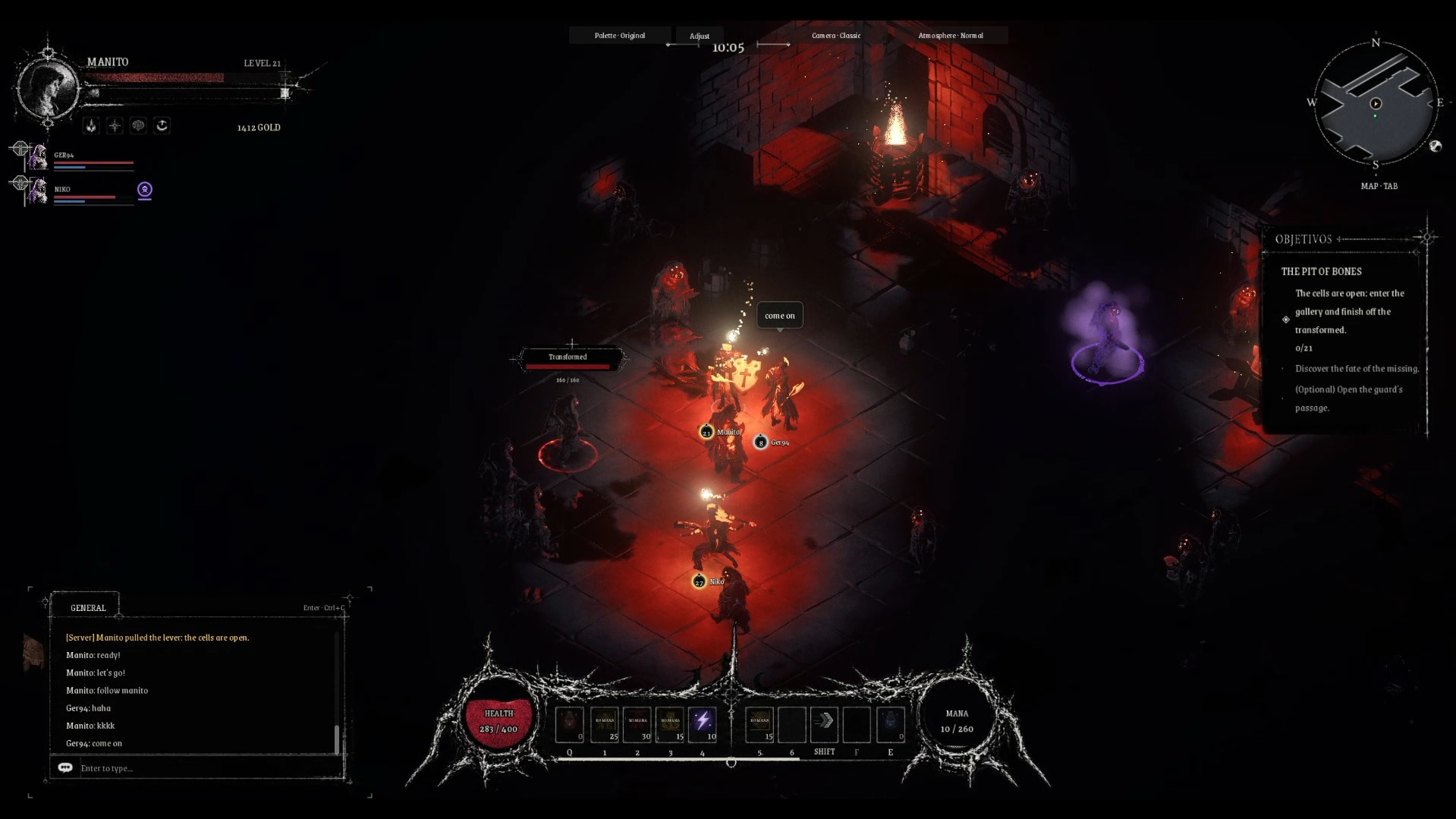
Puedes entrar al lobby, interactuar con otros jugadores, empezar una partida y jugarla solo o invitar a otros. Ahora mismo tenemos un tutorial y dos mazmorras distintas. Las mazmorras tienen objetivos diferentes, misiones secundarias y NPCs. También tenemos un sistema de habilidades, vida y maná y, por supuesto, ¡puedes morir! Cada NPC te da experiencia, oro y botín al ser derrotado. Al final de cada mazmorra verás tus recompensas. También hay un comerciante donde puedes comprar y vender objetos, aunque algunos objetos concretos solo se pueden conseguir en las mazmorras.
Además de presentar el juego, en este primer post quería compartir el enfoque que decidimos tomar para la arquitectura multijugador, al menos a grandes rasgos (pienso profundizar más en próximos posts).
A diferencia de varios MMOs hechos en Godot (y también en otros motores) que implementaron el servidor en un framework aparte, nosotros decidimos usar Godot tanto para el cliente como para el servidor. Los motivos principales son:
- Queríamos un servidor totalmente autoritativo, y es mucho más fácil usar Godot para eso que reimplementar la capa de físicas en otra tecnología.
- Aunque nuestro juego tiene un lobby donde todos los jugadores pueden interactuar, el juego en sí, con NPCs, botín, etc., sucede en "partidas" individuales que solo reúnen a un pequeño grupo de jugadores que deciden jugar juntos. Así que la complejidad está en otro sitio: cómo gestionar bien estas partidas, en lugar de tener un gran mundo abierto que hay que manejar con muchísimo cuidado.
- Si algún día tenemos mucha gente interactuando en el lobby, podríamos repartirla entre varios lobbies (preferimos escalar horizontalmente antes que añadir más complejidad a la implementación).
- Tanto el lobby como cada servidor de partida se ejecutan como procesos independientes, así que si un servidor de partida se cae, no afecta a los demás. Esto también facilita aislar los problemas y gestionar cada partida por separado.
Las principales desventajas son que compartir el mismo código entre cliente y servidor puede ser un poco caótico y cuesta acostumbrarse al principio, y que el consumo de recursos va a ser, sin duda, mayor. Sin embargo, esto nos permitió avanzar muy rápido con una arquitectura clara y fácil de entender, y eso es lo que más valoramos ahora mismo.
Básicamente, tenemos el servidor del lobby y cada servidor de partida ejecutándose como procesos de Godot sin interfaz gráfica (headless) en la misma máquina (esto puede cambiar en el futuro si hace falta). El lobby "gestiona" los servidores de partida y se comunica con ellos internamente a través de una interfaz de administración. Luego el jugador pasa del lobby al servidor de partida y viceversa, y así es, más o menos, como funciona.
Así que sí, claro que esto tiene un coste extra y no podemos tener miles de partidas simultáneas en la misma máquina, pero ahora mismo eso no nos preocupa. Si alguna vez llega a ser una necesidad real, estaremos preparados para escalar horizontalmente.
Por supuesto, nuestra arquitectura multijugador tiene mucho más de lo que he explicado aquí. Como es nuestro primer post, no quería entrar en demasiado detalle, y pienso tratar más aspectos en próximos posts. Pero si tienes cualquier pregunta sobre cómo funciona algo, ¡pregunta sin problema! Estaré encantado de responder.
En cuanto a lo visual, compramos algunos assets y también estamos usando animaciones de Mixamo. Tenemos pensado cambiar por completo la interfaz, el HUD (¡antes de que digas que es feo! jaja), etc. Incluso usamos IA para generar algunas de estas cosas, pero son totalmente provisionales. Queremos arte original, y por eso ahora mismo estamos buscando un ilustrador que se una al equipo. Eso sí, pusimos mucho esfuerzo en los VFX, los shaders, la iluminación, etc., para definir nuestro propio estilo.
Por último, en próximos posts me gustaría hablar de cómo usamos la IA durante el desarrollo. Al principio apenas la usábamos, porque queríamos definir y, sobre todo, entender una arquitectura que tuviera sentido para nosotros, y también aprender cómo funciona el motor.
Pero una vez que tuvimos una base sólida, empezamos a usar la IA en el desarrollo diario, y eso nos permitió avanzar mucho más rápido. Creemos que la IA puede ser una herramienta realmente útil para un equipo pequeño como el nuestro, siempre que entiendas lo que estás construyendo y no te fíes a ciegas de todo lo que genera.
Bueno, al final este post me quedó mucho más largo de lo que esperaba, jaja.
Todavía estamos aprendiendo muchísimo y hay un montón de cosas por mejorar, pero estamos muy ilusionados con lo que hemos construido hasta ahora.
Nos encantaría saber qué opinas, ¡sobre todo si ya has trabajado en juegos multijugador con Godot!
Además, estamos buscando gente interesada en probar nuestra pre-alfa :)
¡Gracias por leer!
Hello!
We're a team of three people developing Noctara, a dark fantasy, 3D ARPG in Godot. I'm the only programmer, and then we have the game designer and the art director. We started this project almost 6 months ago and this is the first time we've decided to show something because we're proud of what we've built so far. However, we know we're still missing tons of things.
The current state of the project can be described like this (I prefer this over a bullet list):
You can enter the lobby, interact with other players, start a game and play it alone or invite others. Right now, we have a tutorial and two different dungeons. The dungeons have different goals, secondary missions and NPCs. We also have a skill system, health and mana, and of course, you can die! Each NPC gives you XP, gold and loot when defeated. At the end of each dungeon, you'll see your rewards. There's also a trader where you can buy and sell items, but some specific items can only be obtained from the dungeons.
Besides introducing the game, I wanted to share in this first post the approach we decided to take for the multiplayer architecture, at least a high-level overview (I'm planning to go deeper in future posts).
Unlike several other Godot (and other engines as well) MMOs that implemented the server in a separate framework, we decided to use Godot for both the client and the server. The main reasons behind this are:
- We wanted a fully authoritative server, and it's much easier to use Godot for that than to reimplement the physics layer in another technology.
- Even though our game has a lobby where all players can interact, the actual gameplay with NPCs, loot, etc. happens in individual "games" that only hold a small team of players who decide to play together. So this puts the complexity in a different place: how to properly manage these games, instead of having one big open world that needs to be handled very carefully.
- If we ever have a lot of people interacting in the lobby, we could potentially distribute them across several lobbies (we prefer to scale horizontally rather than adding more complexity to the implementation).
- Both the lobby and each game server run as independent processes, so if one game server crashes, it won't affect the others. This also makes it easier to isolate problems and manage each game independently.
The main downsides are that sharing the same codebase between the client and server can be a bit messy and hard to get used to at first, and that resource consumption is for sure going to be higher. However, this allowed us to move very fast with a clear and easy-to-understand architecture, and that's what we value right now.
Basically, we have the lobby server and each game server running as separate headless Godot processes on the same machine (this can change in the future if needed). The lobby "manages" the game servers and communicates with them internally through an admin interface. Then the player is redirected from the lobby to the game server and vice versa, and that's pretty much how it works.
So yes, of course this comes with some overhead, and we can't have thousands of concurrent games running on the same machine, but we don't really care about that right now. If that's ever a real need, we're going to be ready to scale horizontally.
Of course, there's a lot more to our multiplayer architecture than what I've explained here. Since this is our first post, I didn't want to go into too much detail, and I'm planning to cover more of it in future posts. But if you have any questions about how anything works, feel free to ask! I'll be more than happy to answer.
Regarding the visuals, we bought some assets and we're also using Mixamo animations. We're planning to completely change the UI, HUD (before you say it's ugly! haha), etc. We even used AI to generate some of these things, but they're absolutely temporary. We want original artwork, and that's why we're currently looking for an illustrator to join our team. We did put a lot of effort into the VFX, shaders, lighting, etc. in order to define our own style.
Finally, in future posts I'd like to talk about how we used AI during development. At the beginning, we barely used it because we wanted to define and, most importantly, understand an architecture that made sense for us, and also learn how the engine works.
But after we had a solid base, we started using AI for daily development, and that allowed us to move much faster. We think AI can be a really useful tool for a small team like ours, as long as you understand what you're building and don't blindly trust everything it generates.
Well, this ended up being a much longer post than I expected haha.
We're still learning a lot and there's plenty of stuff to improve, but we're really excited about what we've built so far.
Would love to hear your thoughts, especially if you've worked on multiplayer games in Godot before!
Also, we're looking for people interested in testing our pre-alpha :)
Thanks for reading!
大家好!
我们是一个三人团队,正在用 Godot 开发 Noctara——一款暗黑奇幻风格的 3D ARPG。我是团队里唯一的程序员,另外还有一位游戏设计师和一位美术总监。这个项目我们已经做了将近 6 个月,这是我们第一次决定拿出来给大家看看,因为我们为目前做出的成果感到自豪。不过我们也清楚,还有大量的东西没有完成。
项目目前的状态可以这样描述(比起列清单,我更喜欢这样讲):
你可以进入大厅,和其他玩家互动,开始一局游戏,单人游玩或者邀请其他人一起。目前我们有一个教程关卡和两个不同的地下城。每个地下城都有不同的目标、支线任务和 NPC。我们还有技能系统、生命值和法力值,当然,你也会死!每个 NPC 被击败后都会给你经验、金币和战利品。每个地下城结束时,你会看到自己的奖励。此外还有一个商人,你可以在那里买卖物品,不过有些特定物品只能在地下城里获得。
除了介绍游戏之外,我还想在这第一篇日志里分享一下我们为多人联机架构选择的方案,至少是一个整体概览(我打算在之后的日志里深入讲解)。
不少用 Godot(以及其他引擎)开发的 MMO 会用一个单独的框架来实现服务器,而我们决定客户端和服务器都使用 Godot。主要原因如下:
- 我们想要一个完全权威的服务器,而用 Godot 来实现这一点,比用另一种技术重新实现物理层要容易得多。
- 虽然我们的游戏有一个所有玩家都可以互动的大厅,但真正的游戏内容——NPC、战利品等等——发生在一局局独立的“游戏”中,每局只容纳一小队决定一起玩的玩家。这样一来,复杂性就转移到了别处:如何妥善管理这些游戏局,而不是去应付一个需要小心翼翼处理的大型开放世界。
- 如果将来大厅里有大量玩家在互动,我们可以把他们分配到多个大厅(相比给实现增加更多复杂性,我们更倾向于横向扩展)。
- 大厅和每个游戏服务器都作为独立进程运行,所以一个游戏服务器崩溃不会影响其他服务器。这也让我们更容易隔离问题,并独立管理每一局游戏。
主要的缺点是:客户端和服务器共用同一套代码,一开始可能有点混乱,也不太容易习惯;另外资源消耗肯定会更高。不过,这让我们能够以一个清晰易懂的架构快速推进,而这正是我们现阶段最看重的。
简单来说,大厅服务器和每个游戏服务器都作为独立的无界面(headless)Godot 进程运行在同一台机器上(如果需要,将来可能会改变)。大厅负责“管理”各个游戏服务器,并通过一个管理接口在内部与它们通信。然后玩家会从大厅被转到游戏服务器,再从游戏服务器回到大厅,大致就是这样运作的。
所以没错,这当然会带来一些额外开销,我们也没法在同一台机器上同时运行成千上万局游戏,但目前我们并不在意这一点。如果将来真的有这个需要,我们也已经准备好横向扩展了。
当然,我们的多人联机架构远不止我在这里讲到的这些。因为这是我们的第一篇日志,我不想讲得太细,之后的日志里我打算介绍更多内容。不过如果你对任何部分的工作原理有疑问,尽管提问!我非常乐意解答。
画面方面,我们购买了一些素材,也在使用 Mixamo 的动画。我们打算彻底更换 UI、HUD(在你说它丑之前!哈哈)等等。其中一些东西我们甚至是用 AI 生成的,但它们绝对只是临时的。我们想要原创美术,所以目前正在寻找一位插画师加入团队。不过,我们在视觉特效、着色器、光照等方面下了很大功夫,以确立我们自己的风格。
最后,在之后的日志里,我想聊聊我们在开发过程中是如何使用 AI 的。一开始我们几乎不用它,因为我们想先确立、更重要的是真正理解一套适合我们的架构,同时也想学习引擎是如何运作的。
但在打下扎实的基础之后,我们开始在日常开发中使用 AI,这让我们的进度快了很多。我们认为,对于像我们这样的小团队来说,AI 可以是一个非常有用的工具,前提是你理解自己在构建什么,并且不盲目相信它生成的一切。
好吧,这篇日志最后写得比我预想的长多了,哈哈。
我们仍在不断学习,还有很多地方需要改进,但我们对目前做出的成果真的感到很兴奋。
很想听听你的想法,特别是如果你之前用 Godot 做过多人游戏的话!
另外,我们正在寻找有兴趣测试我们 pre-alpha 版本的玩家 :)
感谢阅读!